Microbial Metabolites and Human Health Take Center Stage at ISB’s 2025 Virtual Microbiome Symposium
Six leading experts from across the field presented new insights to more than 1,000 registrants worldwide, with over 400 participants joining live.

More than 1,000 people — including researchers, clinicians, and trainees — from over 70 countries registered online for the Institute for Systems Biology’s 2025 Virtual Microbiome Symposium, a free, global event focused on one of the fastest-moving frontiers in biomedical science: how microbial metabolites shape human physiology, development, and disease.
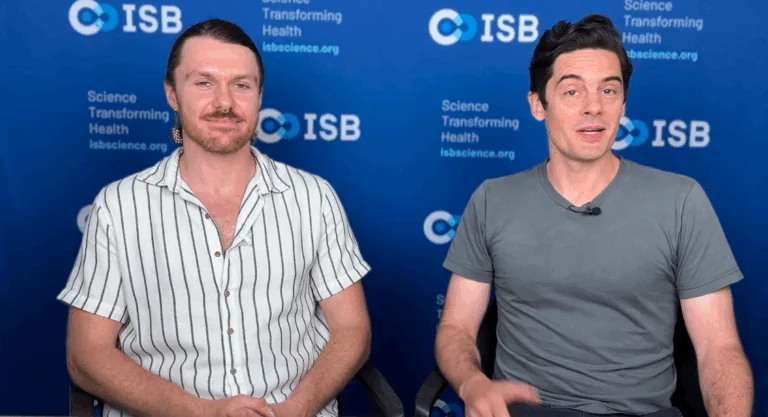
Co-directed by ISB faculty members Drs. Sean Gibbons and Sid Venkatesh, the symposium brought together leading experts working across immunology, neuroscience, metabolism, chemistry, and microbiology to discuss recent advances in this rapidly-growing field.
The symposium builds on ISB’s interest in discovering and characterizing novel gut microbial metabolites, understanding their impacts on the host physiology, and learning how to engineer their production or consumption rates in vivo. Venkatesh’s postdoctoral work resulted in the development of microbiota-directed therapeutic foods and the identification of a gut microbial fatty acid amide hydrolase that affects satiety-related pathways in malnourished children and generates novel metabolites with pharmacological effects. The Gibbons Lab has developed widely-used tools for community-scale metabolic modeling, which have enabled personalized nutritional interventions designed to optimize butyrate production and pathobiont colonization resistance.
Throughout the day, speakers emphasized a shared shift in the field — moving beyond cataloging which microbes are present to understanding what they do, how their molecular products interact with host systems, and how those interactions might be harnessed for therapy.
The program opened with remarks underscoring the rapid maturation of microbiome science and the importance of grounding discovery in mechanism and translation. From there, the symposium unfolded across a series of talks highlighting how microbial metabolites influence health across the lifespan.
Dr. Brittany Needham explored the chemical dialogue between microbes and the nervous system, revealing how bacterial metabolites interact with host signaling pathways and contribute to neurophysiology. Dr. Giada De Palma followed with insights into gut–brain communication and visceral pain, drawing on translational studies that connect microbial metabolism to sensory signaling in disorders such as irritable bowel syndrome.
The focus then shifted to early life, where microbial exposures can have outsized and lasting effects. Dr. June Round examined how the neonatal microbiome shapes immune and metabolic development, emphasizing critical windows during which microbial signals influence long-term health trajectories. Dr. Melody Zeng extended this theme across infancy and pregnancy, presenting work that links microbiome-derived metabolites to immune tolerance, viral responses in preterm infants, and maternal–fetal health.
In the afternoon session, attention turned to diet and metabolism. Dr. Matthew Carter presented findings from the Twins Nutrition Study, a randomized clinical trial comparing vegan and omnivorous diets in identical twins. By integrating multi-omics data with mechanistic validation in model systems, Carter highlighted how dietary patterns can reshape the microbiome in ways that influence circulating metabolites and metabolic health.
Closing the scientific program, Dr. Matthew Redinbo delivered a capstone talk on gut microbial enzymes and their role in regulating drugs, hormones, and neurotransmitters. His work reframes the microbiome as an active biochemical organ, capable of modulating both local and systemic signaling molecules, with implications for drug efficacy, side effects, and homeostasis.
The symposium concluded with a lively panel discussion moderated by Gibbons and Venkatesh. The conversation tackled big-picture questions facing the field: How fast is microbiome science translating to the clinic? Should researchers prioritize deep mechanistic studies or large-scale human investigations? How much effort should be devoted to discovering unknown metabolites versus understanding well-established ones? Panelists also shared candid advice for trainees entering this interdisciplinary space and offered forward-looking perspectives on the future of microbiome-based therapies.
ISB extends its gratitude to the symposium’s generous sponsors — Applied Microbiology International, LIV, Pendulum, and Science in Seattle — whose support made the event freely accessible to a global audience. Special thanks also go to session chairs Dr. Nate Ritz, Dr. Alex Carr, and Crystal Perez, and to the ISB team behind the scenes who ensured a seamless virtual experience.
Below, you’ll find the full symposium recordings, available to watch on demand. We invite you to explore the talks in order and stay connected with ISB as we continue advancing systems biology research in 2026 and beyond. Prefer to watch all sessions in a single playlist? View the full playlist on YouTube.
Sid Venkatesh, PhD
“Brain-Relevant Microbial Metabolites”
Introduced by Nate Ritz, PhD
“The role of gut microbiota in pain neurotransmission”
Introduced by Nate Ritz, PhD
“Microbiota-Immune interactions that promote health”
Introduced by Alex Carr, PhD
“Gut microbiota-immune system crosstalk in early life”
Introduced by Alex Carr, PhD
“Dietary modulation of a gut pathobiont links microbial amino acid metabolism to host health”
Introduced by Crystal Perez
“Gut Microbial Enzymes Influence Host Endobiotic Homeostasis”
Introduced by Crystal Perez
Chaired by Sid Venkatesh, PhD and Sean Gibbons, PhD
Sean Gibbons, PhD